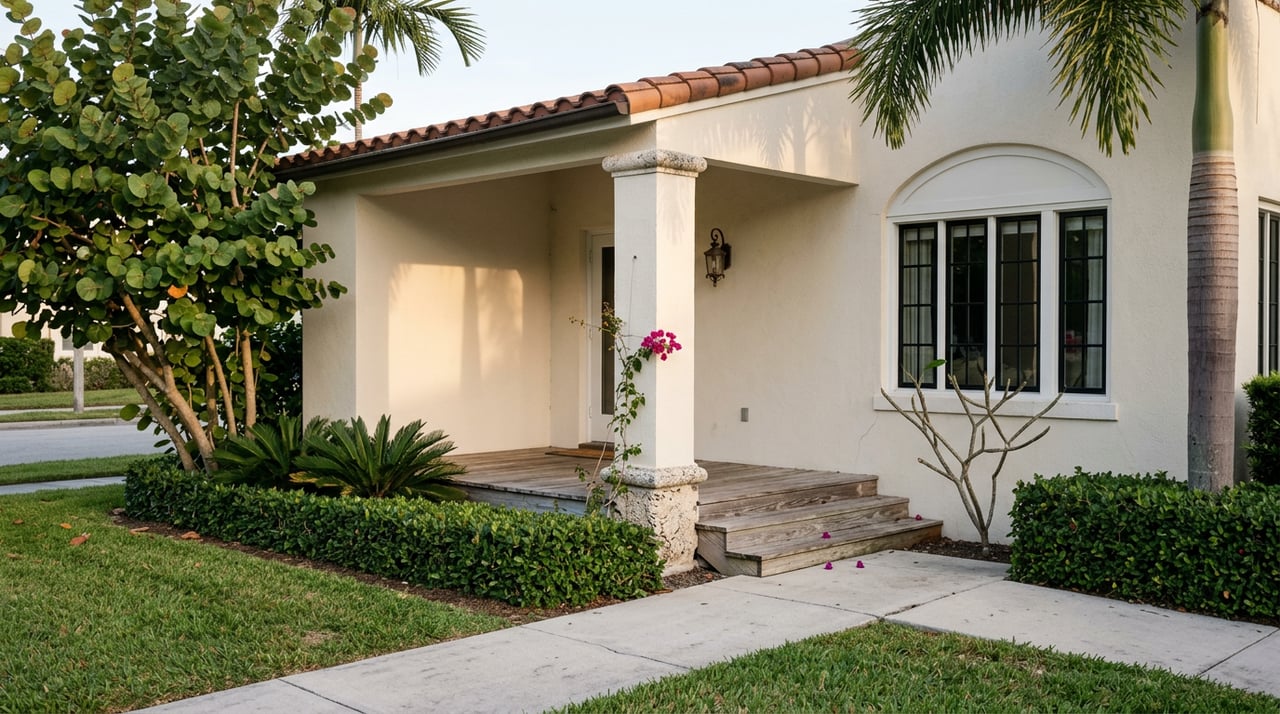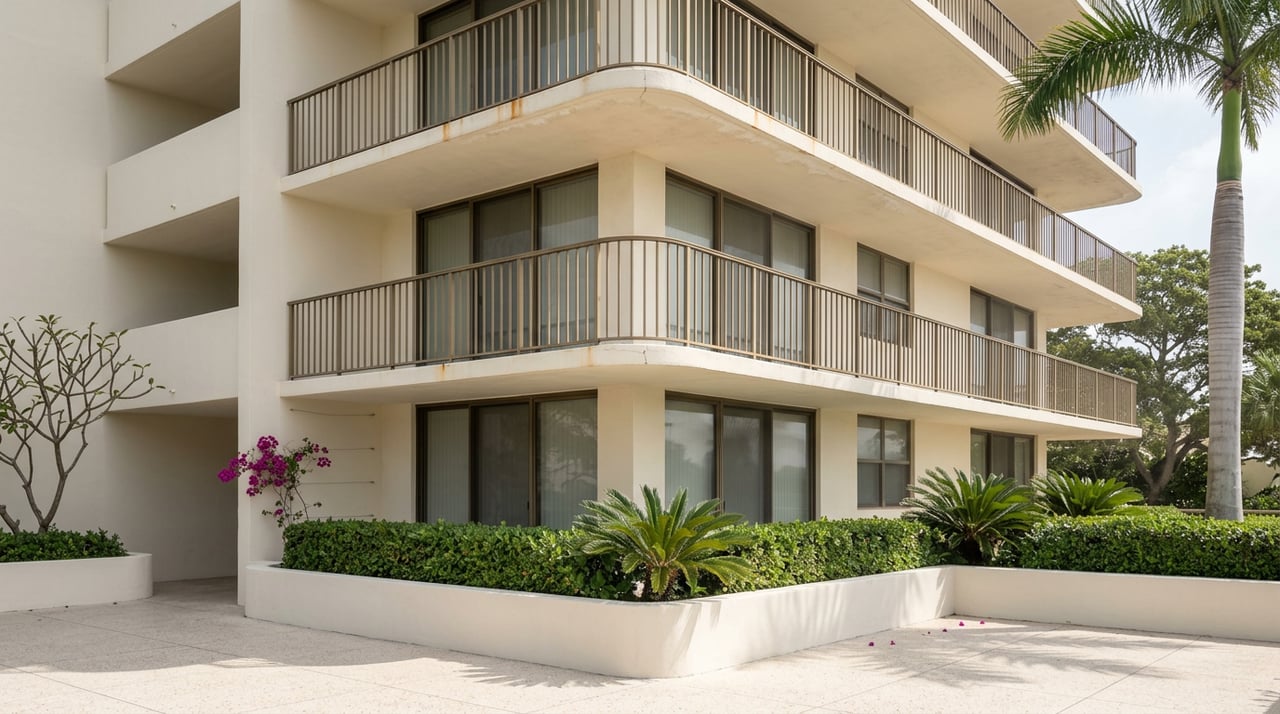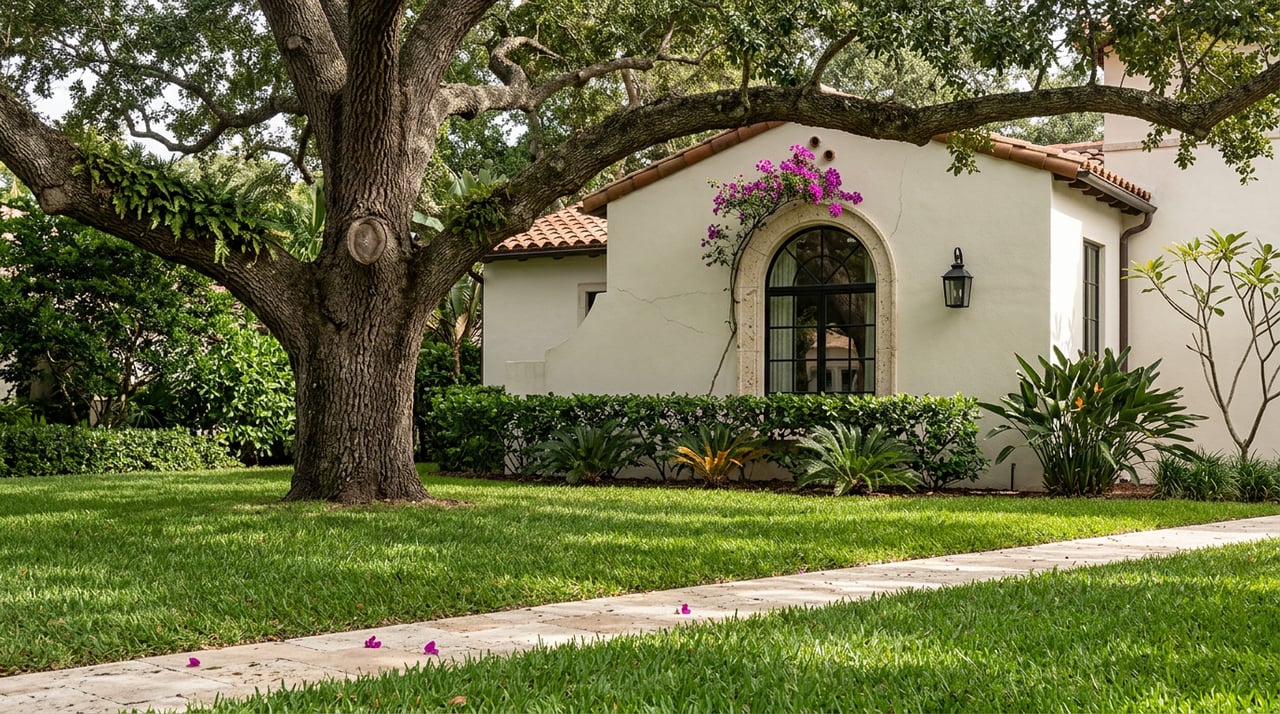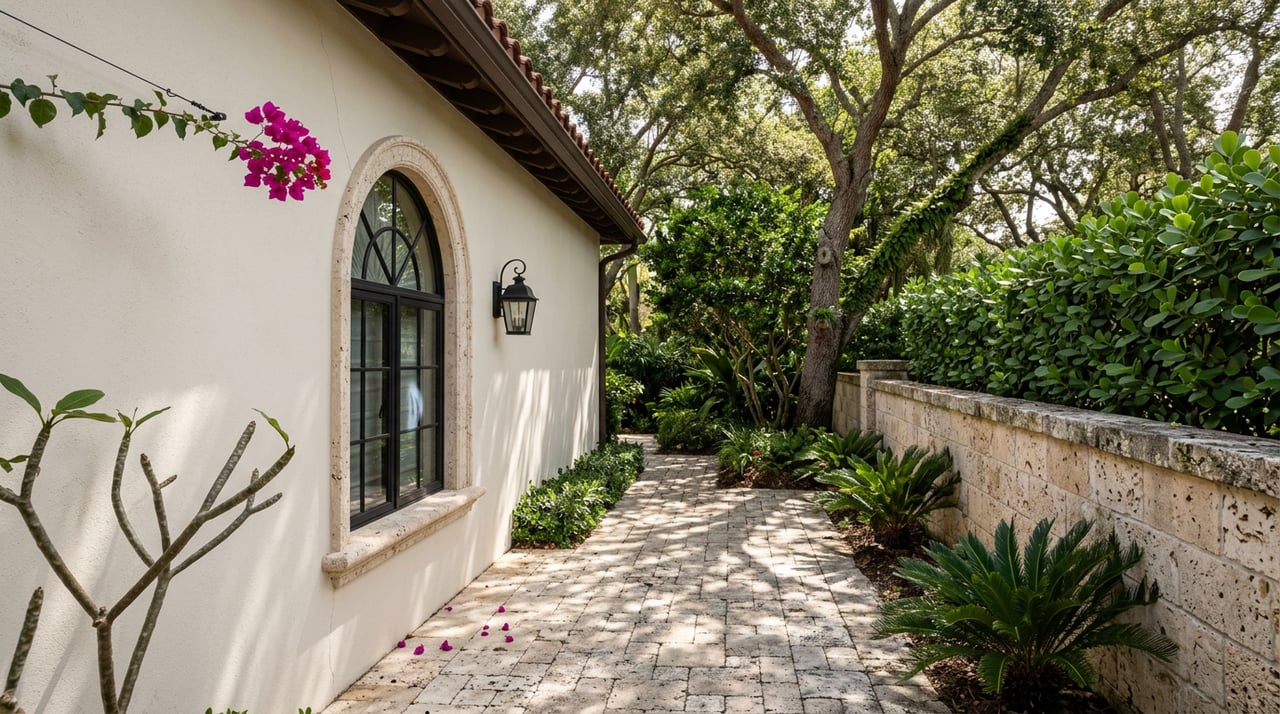
A Coconut Grove waterfront listing looks the same from the patio in July as it does in January. The oak canopy, the coral-stone terrace, the view across Biscayne Bay toward Key Biscayne. What changes between those two showings is almost never the house. It is what a marine engineer would find if you asked one to swim the wall.
That is the Grove waterfront market in a sentence. Buyers underwrite a view. Sellers price a lot. The deal, when it moves, moves on a structure most people never see.
The 114-Day Tell
Coconut Grove's overall single-family market ran at a median sale price near $2.6 million and roughly 87 days on market through mid-2026, at about $909 per square foot. Waterfront homes inside that same market sat closer to 114 days before going under contract, more than double the neighborhood median, and still closed at the standard Grove discount of about 9.4% off list. Water views cost time, not money.
That gap is the friction. It is not scarcity of buyers. Coconut Grove's waterfront had 76 active listings and 44 recorded sales the month before, and 2026 listing volume was tracking about 75% above 2025's pace. The delay is diligence. Serious buyers are pulling engineer-sealed seawall reports, dock permits, and bathymetric readings before they will sign, and every one of those steps takes calendar days that unrepresented sellers rarely plan for.
What Everyone Is Actually Inspecting
Miami's oldest neighborhood carries some of its oldest private shoreline infrastructure. Parts of the South Grove bayfront, along stretches of South Bayshore Drive, Sailboat Bay, Bay Heights, Tigertail Avenue, and the Dinner Key area, still stand on concrete seawalls built between the 1940s and the 1960s. Those walls were designed for a different century's water levels and a different century's boat wakes.
Age shows up in a short list of predictable defects:
- Splash-zone spalling on the wall cap, with chloride corrosion exposing rebar
- Corroded or slack tiebacks behind the wall, addressed with helical anchoring
- Soil piping through joint failures, appearing as yard depressions or sinkholes and cured with polyurethane foam injection
- Toe scour at the base, invisible from land and only measurable by a diver
- Panel lean out of vertical
None of that is visible from a terrace. The reason Grove waterfront transactions turn on marine engineering is that Florida law treats those conditions as latent defects the moment the seller knows about them.
The Permit Stack a Buyer Should Read Before Closing
Any repair, replacement, or modification touching submerged land in the Grove sits inside a stacked permit process that runs through several agencies at once.
| Trigger | Reviewing body | Typical friction |
|---|---|---|
| Structural review, waterfront setback | City of Miami Building Department, Chapter 29 waterfront regulations | Zoning and setback verification |
| In-water work, submerged lands | Miami-Dade DERM Class I Coastal Permit | Aquatic Preserve consultation for bayfront parcels |
| Fill, dredge, dock footprint | U.S. Army Corps of Engineers, Florida DEP | Seagrass survey and mitigation |
| Replacement elevation | Miami-Dade County | 6.0 ft NAVD88 cap standard |
Cap repair and tieback work that does not disturb submerged lands often qualifies for an expedited authorization of roughly ten days. Full replacement inside the Biscayne Bay Aquatic Preserve is a different animal, and most bayfront replacements now integrate riprap or hybrid shorelines because agencies increasingly ask applicants to evaluate a living-shoreline alternative before approving a new vertical wall. That agency preference matters at the negotiating table. A wall that cannot simply be rebuilt in kind may need a full redesign, and that is a line item that belongs in the purchase price, not the punch list.
The Disclosure Rule That Reshapes the Negotiation
Florida has been a mandatory disclosure state for residential real estate since the Florida Supreme Court decided Johnson v. Davis, 480 So.2d 625 (Fla. 1985). The rule is short.
Where the seller of a home knows of facts materially affecting the value of the property which are not readily observable and are not known to the buyer, the seller is under a duty to disclose them.
Three details matter for waterfront sellers in the Grove.
First, an "as-is" contract does not defeat the duty. Florida appellate courts have said so repeatedly, most cited among them Rayner v. Wise Realty Co. of Tallahassee and Levy v. Creative Construction Services. A seller who checks "no" on every box of a property condition form can still be liable if they actually knew of a defect and left it off.
Second, the statute of limitations does not run from closing. It runs from the date the buyer discovered or should have discovered the defect. Buried tieback corrosion or a hollowed backfill can surface years later. A four-year discovery-rule clock on a multi-million-dollar wall is not a footnote.
Third, real estate licensees carry an independent duty under Florida Statute §475.278 to disclose known material facts affecting value that are not readily observable. The listing agent is not a bystander to the seller's decision.
Read together, those three points invert the usual seller instinct on Grove waterfront. Silence is not neutral. Silence is exposure.
The Move That Actually Wins Listings
The listings that trade closest to ask, and closer to the market's 87-day pace than to the waterfront's 114, tend to arrive with the diligence already done. A seller-commissioned engineer's report on the wall and dock, filed before the first showing, does four things at once:
- It converts a latent condition into a disclosed one, cutting the Johnson v. Davis exposure at the root.
- It anchors the price. The seller's number gets to define what "acceptable condition" means, rather than a buyer's late-breaking inspection re-pricing the deal.
- It shortens contract-to-close. A signed and sealed report from a Florida licensed engineer typically satisfies the buyer's lender, the insurance carrier, and the municipality all at once.
- It preempts retrade. A buyer who has the engineer's numbers in hand before submitting has fewer surprises to reopen the price on.
The diligence packet a Grove waterfront seller should assemble reads like this: an above-water and underwater seawall inspection with photographs and measurements, cap and tieback condition documented, bathymetric soundings for depth and obstructions at the dock face, the full permit history for the shoreline and dock, any prior repair invoices and engineer letters, and a current elevation reference against the county's 6.0 ft NAVD88 standard.
What a Buyer Should Ask For, Beyond the Home Inspection
A general home inspector is not a marine engineer, and Johnson v. Davis does not require a buyer to hire one. What it does require, practically, is that a buyer act on a defect that would be obvious to a reasonable inspection. The way to close that gap without giving up leverage is to build the marine scope into the contract from the offer.
- A dedicated seawall and dock inspection period, separate from the general inspection window
- Written scope covering wall face, cap, tiebacks, joints, submerged sections, and toe
- Bathymetric soundings at the intended mooring, especially for buyers planning larger craft
- A full pull of Chapter 29 approvals, DERM Class I permits, and any USACE authorizations tied to the parcel
- Confirmation of Aquatic Preserve status and any mangrove protection overlays
For condominium buyers in Grove waterfront buildings such as Grovenor House, Grove Towers, Yacht Harbour, or Vita at Grove Isle, the seawall lives on the association's balance sheet, not the unit's. That means the diligence extends to the Structural Integrity Reserve Study and, for buildings three stories or taller and within three miles of the coast, the Milestone Inspection required at 25 years under SB 4-D, layered on top of Miami-Dade's recertification program under §8-11(f) of the county code.
A Short FAQ
Does the county actually require a specific seawall elevation? Replacement work in Miami-Dade is engineered to the county's 6.0 ft NAVD88 standard, with riprap integration on bayfront parcels inside the Biscayne Bay Aquatic Preserve. Older walls built to earlier standards are grandfathered until they are replaced, which is one reason repair is often preferred over full replacement while the wall still qualifies.
Is riprap always the answer if the wall fails? No. A vertical wall gives deeper water at the edge and simpler mooring. Riprap absorbs wave energy and reads better ecologically but shortens usable dock depth. The right answer is parcel-specific and depends on bottom profile, seagrass presence, and how the owner intends to use the water.
Can we just sell "as-is" and skip the marine inspection? An as-is clause does not defeat the Johnson v. Davis duty to disclose a known material defect. The exposure travels with the seller for four years from the buyer's discovery of the defect, not from closing.
Why does the waterfront sit longer than the rest of the Grove market? Because the diligence is real, and it takes real time. A buyer who is spending seven or eight figures on a bayfront parcel is going to price the wall before they price the house. Listings that arrive without an engineer's report absorb that time inside the marketing window. Listings that arrive with one usually do not.
The Grove waterfront rewards owners who treat the shoreline as part of the presentation. A wall that has been inspected, disclosed, and documented is not a liability on the marketing packet. It is the reason the offer comes in clean.
For a private conversation about pricing a Grove waterfront listing or building the marine-diligence scope into a purchase offer, Randi Connell is available to schedule a consultation.