A pattern is showing up in Mid-Beach contracts this summer that has little to do with the unit itself. The buyer loves the layout. The seller has already priced the unit to reflect the building's age. Both sides have signed off on the walkthrough. Then, somewhere around week five or six, the lender comes back with a different answer than anyone expected: the building itself does not qualify for the loan.
This is not a story about a failed inspection or a hidden leak. It is a story about who is allowed to check a condo association's finances before a mortgage gets approved, and how closely. As of August 3, 2026, that checking process changed for every conventional condo loan in the country, and Miami Beach's mid-century high-rises are feeling it first.
What Actually Changed on August 3
For years, Fannie Mae used two review tracks for condo loans. A shortcut called Limited Review let a lender approve financing in a large, seemingly healthy building without auditing every financial detail of the association. A deeper Full Review, reserved for smaller buildings or ones already flagged as risky, went through the association's reserves, insurance, litigation history, and owner-occupancy numbers line by line.
Fannie Mae and Freddie Mac retired the shortcut. Lender Letter LL-2026-03, issued March 18, 2026, eliminates Limited Review for loan applications dated August 3, 2026 or later. Every conventional condo loan now goes through the version of underwriting that used to apply only to buildings the industry already worried about.
This matters because Florida's own building safety reforms run on a separate timeline from Fannie Mae's underwriting rules. The milestone inspection law and the Structural Integrity Reserve Study requirement that followed the Champlain Towers South collapse in Surfside were written to keep buildings standing. They were never written to keep loans flowing. A building can be fully compliant with the state, inspection completed, reserve study filed, and still fail a federal Full Review over something the state law never asked about: an insurance deductible, a funding percentage, or an occupancy ratio.
A board that finished its milestone inspection and its Structural Integrity Reserve Study on schedule has done the legal minimum. It has not necessarily done what a Fannie Mae underwriter now checks for on every file.
Why Condo Canyon Feels This First
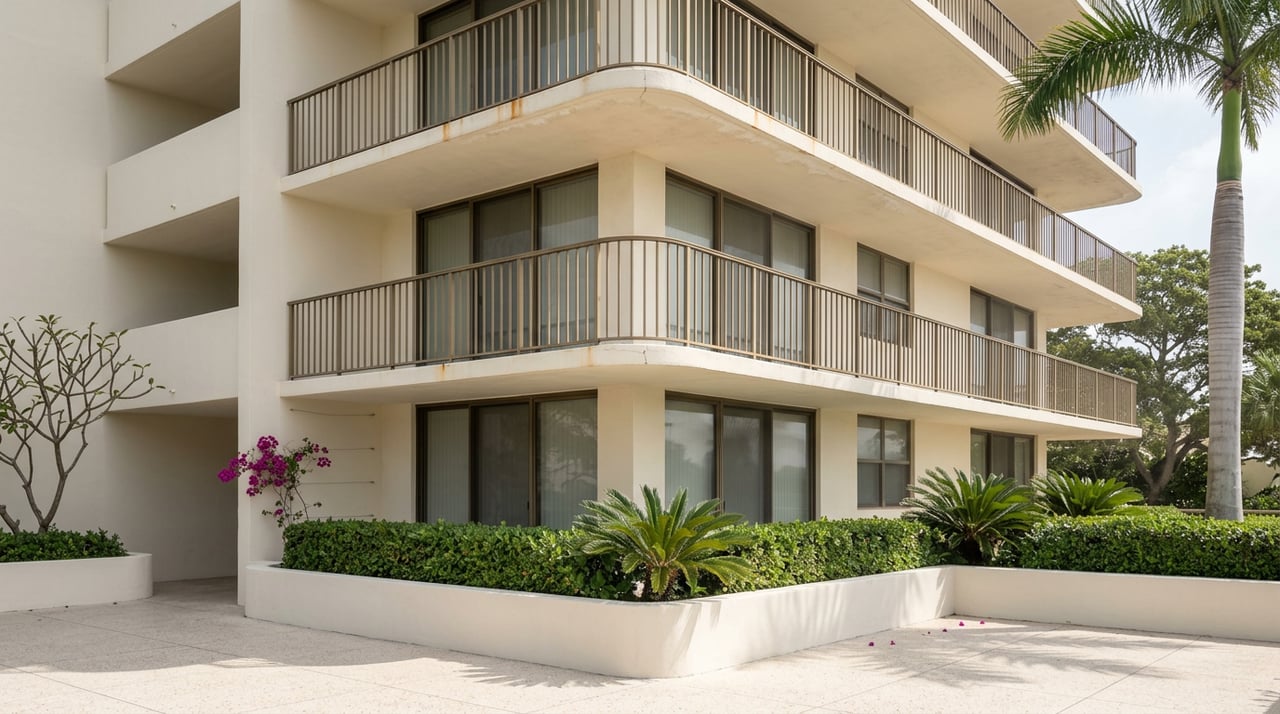
Mid-Beach's Collins Avenue corridor holds one of the largest concentrations of exactly the buildings this rule targets: residential towers built in the 1950s and 1960s, three stories or taller, many inside what the City of Miami Beach designated in 2009 as the Morris Lapidus/Mid-20th Century Historic District. Locals have nicknamed this stretch Condo Canyon for a reason. Crystal House, completed in 1960, and Seacoast Towers, completed between 1964 and 1966, are among the district's residential landmarks, buildings old enough to require both a milestone inspection and a reserve study, and large enough that a full underwriting review will price out every capital line on the books.
These are also the buildings most likely to have spent decades on artificially low dues, the exact practice Florida's 2022 reform was written to stop. A reserve study that shows a roof or a facade underfunded does not just mean a special assessment down the road. Under the new review standard, it can mean the building loses its Fannie Mae eligibility today, which shrinks the pool of buyers who can finance a purchase there at all.
The Checklist a Full Review Actually Runs
| Under the old Limited Review | Under the new Full Review |
|---|---|
| Reserve funding rarely verified in detail | Reserve percentage checked against the association's own study |
| Insurance reviewed at a summary level | Per-unit deductible capped at $50,000 for applications dated July 1, 2026 or later |
| Litigation history often not requested | Any pending or threatened litigation reviewed |
| Owner-occupancy assumed from prior filings | Presale and occupancy ratios reverified |
| Delinquency spot-checked | Full delinquency history requested |
A building fails the whole review if it misses on any single line. That is the mechanism turning a routine closing into a stalled one: the unit can be flawless and the loan can still die on the association's paperwork.
What This Means If You Are Selling
The instinct after a reform like this is to wait and see which buildings get flagged. That instinct costs sellers money. A listing that goes under contract without the association's current reserve study, insurance declarations, and delinquency report already assembled is a listing that finds out about a warrantability problem from a nervous buyer's lender, weeks into escrow, after the buyer has already committed emotionally and financially.
Sellers in pre-1990s Miami Beach buildings should request the board's most recent Structural Integrity Reserve Study and insurance declarations before listing, not after an offer arrives. If the numbers show a funding gap, that is useful information too. Miami-Dade County relaunched its Condominium Special Assessment Loan Program in 2026 with a new online application, offering qualifying owners up to $50,000 toward assessment costs. That can be the difference between absorbing a cost at closing and losing the buyer over it.
What This Means If You Are Buying
Ask for warrantability before you write the offer, not during the inspection period. Fannie Mae's Condo Status Finder can confirm whether a specific building already carries an unresolved review issue. If a building has already completed its milestone inspection and funded its reserves, it has usually already absorbed the pain that trips up a Full Review. A building that has done neither still has that pain ahead of it, and a Full Review is now far more likely to surface it before your closing date rather than after.
None of this eliminates a purchase in an older Miami Beach building. Portfolio and non-QM lenders still finance non-warrantable condos, typically at a rate a quarter to a full point higher than conventional. For the right building at the right price, that is a reasonable trade. What has changed is the point in the transaction where you find out you need it.
A Short FAQ
Does this affect single-family homes or townhomes? No. LL-2026-03 governs condominium and cooperative project financing specifically. Single-family and townhome purchases are not subject to condo project review.
Is this a Florida law or a federal rule? Federal. Fannie Mae and Freddie Mac are government-sponsored entities that set their own underwriting guidelines, separate from Florida's SB 4-D, SB 154, and HB 913, which govern milestone inspections and reserve studies at the state level. A building can meet one set of requirements and still miss the other.
Will reserve requirements get stricter again soon? Yes. Fannie Mae's minimum reserve allocation rises from 10 percent to 15 percent of a building's annual budgeted assessment income, effective January 4, 2027. Buildings that are marginal now have roughly a year to close that gap before the next threshold takes effect.
If you are weighing a purchase or a listing in one of Miami Beach's historic Collins Avenue towers, the building's paperwork matters as much as its view right now. Randi Connell can pull the reserve study, the insurance declarations, and the warrantability status on a specific building before you write an offer or set a price, so the only surprises left are the good ones. Schedule a Consultation.